- First, schedule an appointment with the doctor and discuss your problem with him. Then, receive detailed information from the doctor about the causes and specific characteristics of your snoring and/or sleep apnea.
-
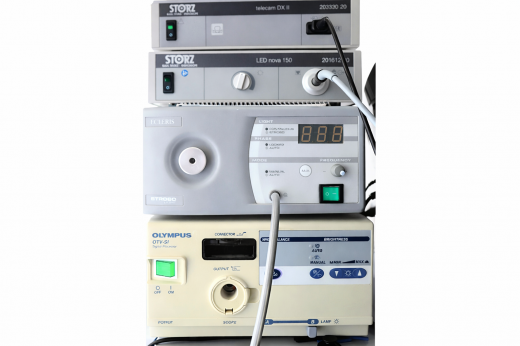
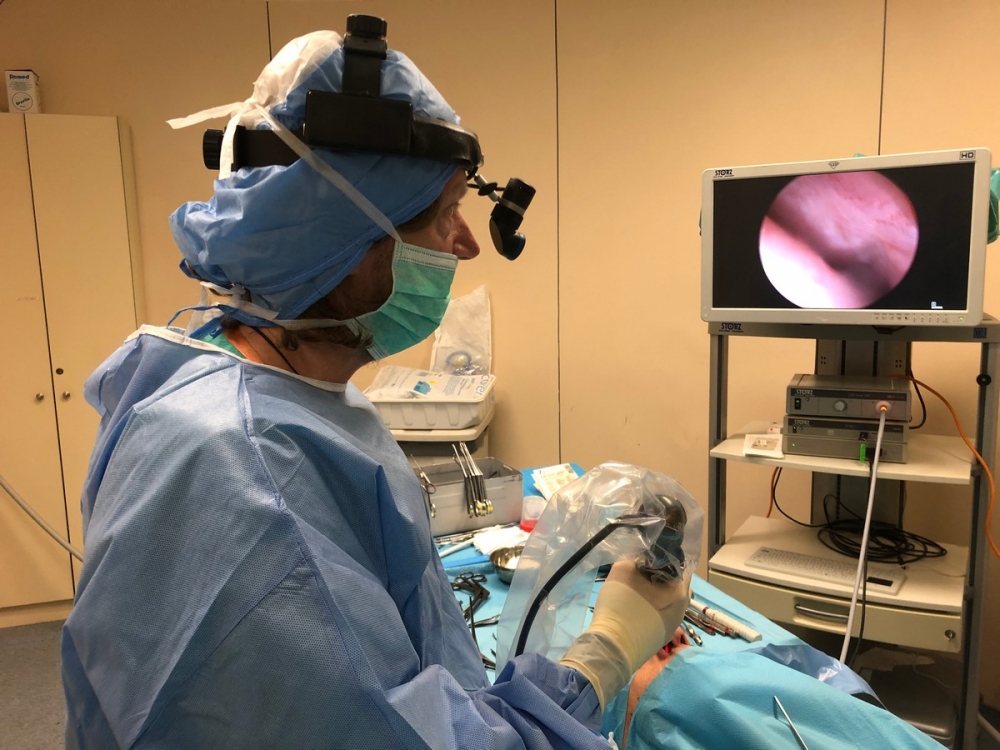
Next, you can also see on the high-definition video camera which anatomical problem, such as the uvula, palatal arches, tonsils, nasal septum, turbinates or adenoids, is responsible for your snoring and/or sleep apnea.
The latest-generation OLYMPUS flexible video endoscope, thanks to its very small diameter of just 3.2 mm, allows easy, painless and rapid examination of the entire upper airway, from the nasal entrance through to the glottis of the larynx and the entrance to the trachea, without interrupting the continuity of the anatomical structures, as the examination is performed in a single continuous passage.In addition, thanks to its special hydrophilic coating and soft, flexible construction, the flexible video endoscope slides more easily as it passes through the soft tissues of the airway, making the examination completely painless. -
The examination requires only very mild local anesthesia of the nose, using a cotton swab soaked in Xylocaine. Depending on the findings of the examination, the doctor informs the patient about the possibility of treating the anatomical causes of snoring or sleep apnea using the most modern surgical techniques.
The flexible endoscopic examination can also be combined with the forced inspiratory effort test (Müller maneuver), performed in either a sitting or supine position. This provides additional information about the levels of upper-airway obstruction, as particularly in severe obstructive sleep apnea syndromes there may be more than one level of obstruction.
The endoscopy video is sent electronically by the clinic's secretary to your email address. -
In cases where there is suspicion of airway obstruction at a lower level of the larynx, at the epiglottis, or due to lateral pharyngeal wall collapse, or when previous treatment has already failed, Drug-Induced Sleep Endoscopy (DISE) may be indicated.
This specialized diagnostic examination, through the simulation of sleep that it creates, accurately reveals the levels of airway obstruction responsible for obstructive sleep apnea, particularly when these obstructions are located deep within the larynx.
-
In cases where there is suspicion of episodes of sleep apnea, the patient can immediately obtain the Snore-Check device from the clinic and undergo a snoring recording and digital sleep study that same night.
The results are analyzed by the Sleep Medicine Center - Primary Care and communicated to the patient as early as the following day.
The Snore-Check recording serves as a screening test to confirm whether a full sleep study is necessary in cases where severe sleep apnea syndrome is suspected. -
Snoring Treatment and Sleep Apnea Treatment with Ultrasound: In severe cases of snoring and in cases of obstructive sleep apnea (OSA), the use of ultrasonic surgical technology has in recent years become an ideal treatment option.
This is a state of the art device consisting of a generator that produces high-frequency vibrations, which are transmitted to the ultrasonic cutting instrument. The instrument acts on the anatomical obstruction responsible for snoring, such as the uvula, tonsils, palatal arch, nasal turbinate or cartilaginous nasal septal spur.
In many cases, a simple uvula excision is sufficient to permanently resolve the problem of snoring.
In some cases, a minor surgical procedure on the palatal arches or reduction of the tonsils may also be required to further enlarge the airway.
The entire procedure is bloodless and painless, and its duration does not exceed approximately 15–20 minutes.
In certain cases, the procedure can even be performed without general anesthesia, using a combination of local anesthesia and anesthesiologist-administered sedation. Within a few hours after the procedure, the patient can return home.
The results are immediate, and the patient is relieved from snoring from the very first night.
Postoperative pain, which is considerably milder than that associated with conventional surgery, lasts only a few days. During this period, the patient should follow a special diet consisting of liquid and lukewarm foods.
Are you looking for answers and seeking a solution to your health concerns?
Monday to Thursday: 5 pm - 8 pm and Friday: 10:30 am - 1 pm
Call usOR
Please fill out the contact form: