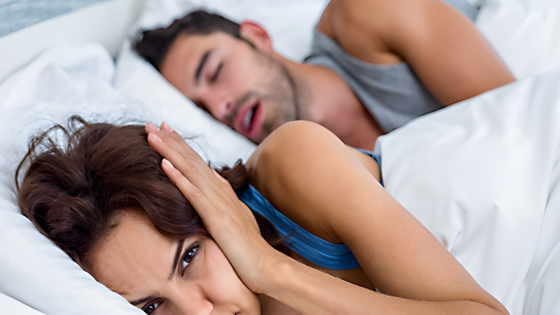
Obstructive Sleep Apnea Snoring and obstructive sleep apnea can affect a high percentage of the population, men, women or even children.
What Is Sleep Apnea?
Any interruption in breathing during sleep that lasts longer than 10 seconds is considered abnormal and is referred to as sleep apnea. When more than 10 apnea episodes occur per hour of sleep, this is referred to as Sleep Apnea Syndrome. According to statistics, 2% to 4% of the population suffers from sleep apnea.
There are three types of sleep apnea:
- Central sleep apnea: Caused by a disorder of the central nervous system.
- Obstructive sleep apnea (OSA): Caused by an obstruction of the upper airway.
- Mixed sleep apnea: Combines features of both central and obstructive sleep apnea.
Mechanism:
Obstructive Sleep Apnea (OSA) is caused by obstruction of the upper airway due to the collapse of the soft palate and pharyngeal walls during sleep. Under normal conditions, the airway remains open thanks to the muscle tone of the muscles of the uvula and pharynx. During sleep, however, muscle tone decreases, resulting in the collapse of the airway walls and obstruction in patients with an underlying anatomical abnormality. This condition is almost always accompanied by loud snoring.
Mechanism of Sleep Apnea – Source: WebMD:
Symptoms of Obstructive Sleep Apnea Syndrome:
In addition to snoring, the symptoms of Obstructive Sleep Apnea Syndrome include frequent awakenings with a sensation of suffocation, night sweats, morning fatigue and sleepiness, irritability, low mood, impaired concentration and attention, reduced performance at work or school, gastroesophageal reflux, nocturnal enuresis (bedwetting), decreased sexual desire, reduced blood oxygen levels, and serious cardiovascular complications such as hypertension and arrhythmias, as well as sudden death.
In general, due to the severe sleep disturbances associated with this condition, patients experience unusual daytime sleepiness, which tends to worsen after lunch. They may even fall asleep while watching a film.
The most dangerous situation, however, is falling asleep while driving. This is relatively common among people suffering from sleep apnea syndrome and can lead to fatal road traffic accidents.
What Causes Obstructive Sleep Apnea?
The most common anatomical obstructions responsible for narrowing the airway and predisposing individuals to snoring and sleep apnea include a deviated nasal septum, hypertrophy of the inferior nasal turbinates, enlarged adenoids, enlarged tonsils and, in particular, an enlarged uvula and narrow palatal arches.
A small lower jaw or a retruded lower jaw (mandibular retrusion), also known as retrognathia, may also be present.
What Are the Main Risk Factors for Obstructive Sleep Apnea?
Important predisposing factors include obesity, a short and thick neck, mandibular retrusion, micrognathia or retrognathia, smoking, alcohol consumption before bedtime, heavy meals shortly before going to bed, sleeping in the supine position (on the back), and the use of sedatives, antidepressants or sleeping pills, among others.
How Is Sleep Apnea Diagnosed?
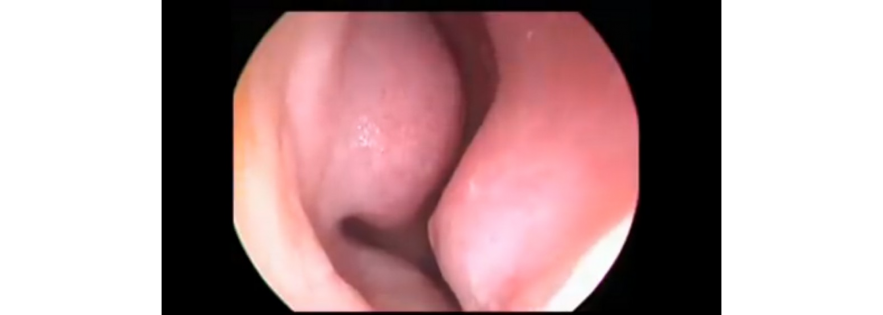
Following a careful medical history of the patient experiencing snoring or episodes of apnea, including information about habits, possible medication use, sleeping position, lifestyle and other relevant factors, an examination is performed using a high-definition video endoscope to identify the anatomical abnormalities responsible for snoring and/or sleep apnea. These may include the uvula, palatal arches, tonsils, nasal septum, nasal turbinates and adenoids.
The latest-generation Olympus flexible video endoscope, with its very small diameter of just 3.2 mm, allows easy, painless and rapid examination of the entire upper airway, from the nasal entrance to the glottis of the larynx and the entrance to the trachea. The examination is performed in a single, continuous passage, allowing the anatomical structures to be examined without interruption.
Furthermore, thanks to its special hydrophilic coating and soft, flexible construction, the endoscope passes more easily through the soft tissues of the airway, making the examination completely painless.
The examination requires only very mild local anesthesia of the nose, using a cotton swab soaked in Xylocaine. Depending on the findings, the doctor informs the patient about the possibility of treating the anatomical causes of snoring or sleep apnea using the most modern surgical techniques.
Flexible endoscopic examination can also be combined with the Müller maneuver, a forced inspiratory effort test performed in either a sitting or supine position. This provides additional information about the levels of upper-airway obstruction, as patients with severe obstructive sleep apnea may have more than one site of obstruction.
Drug-Induced Sleep Endoscopy (DISE) is particularly valuable for identifying the specific anatomical obstructions responsible for apnea and airway blockage at different levels.
The examination is performed under medically induced sedation to simulate sleep, allowing the doctor to identify, with the highest possible degree of reliability, the site responsible for obstruction of airflow through the upper airway.
The procedure is carried out at a specialized center under the supervision of a qualified anesthesiologist. It is relatively quick and is performed under appropriate medical monitoring, providing valuable diagnostic information about the causes of obstructive sleep apnea.
If sleep apnea episodes are suspected, the patient can obtain the Snore-Check device immediately and undergo a snoring recording and digital sleep study that same night.
The results are analyzed by the Sleep Medicine Center - Primary Care and communicated to the patient as early as the following day.
The Snore-Check recording serves as a screening test to determine whether a full polysomnographic sleep study is necessary in cases where severe sleep apnea syndrome is suspected.
When airway obstruction is suspected at the level of the epiglottis (due to a floppy epiglottis) or the larynx (due to laryngomalacia that is not apparent while awake), or when conventional treatment approaches have failed, Drug-Induced Sleep Endoscopy (DISE) may be indicated.
This examination must be performed at a specialized center under anesthesiologist-supervised sedation. It is useful for identifying sites of obstruction below the level of the hypopharynx, particularly within the larynx and at the epiglottis.
Are you looking for answers and seeking a solution to your health concerns?
Monday to Thursday: 5 pm - 8 pm and Friday: 10:30 am - 1 pm
Call usOR
Please fill out the contact form: